

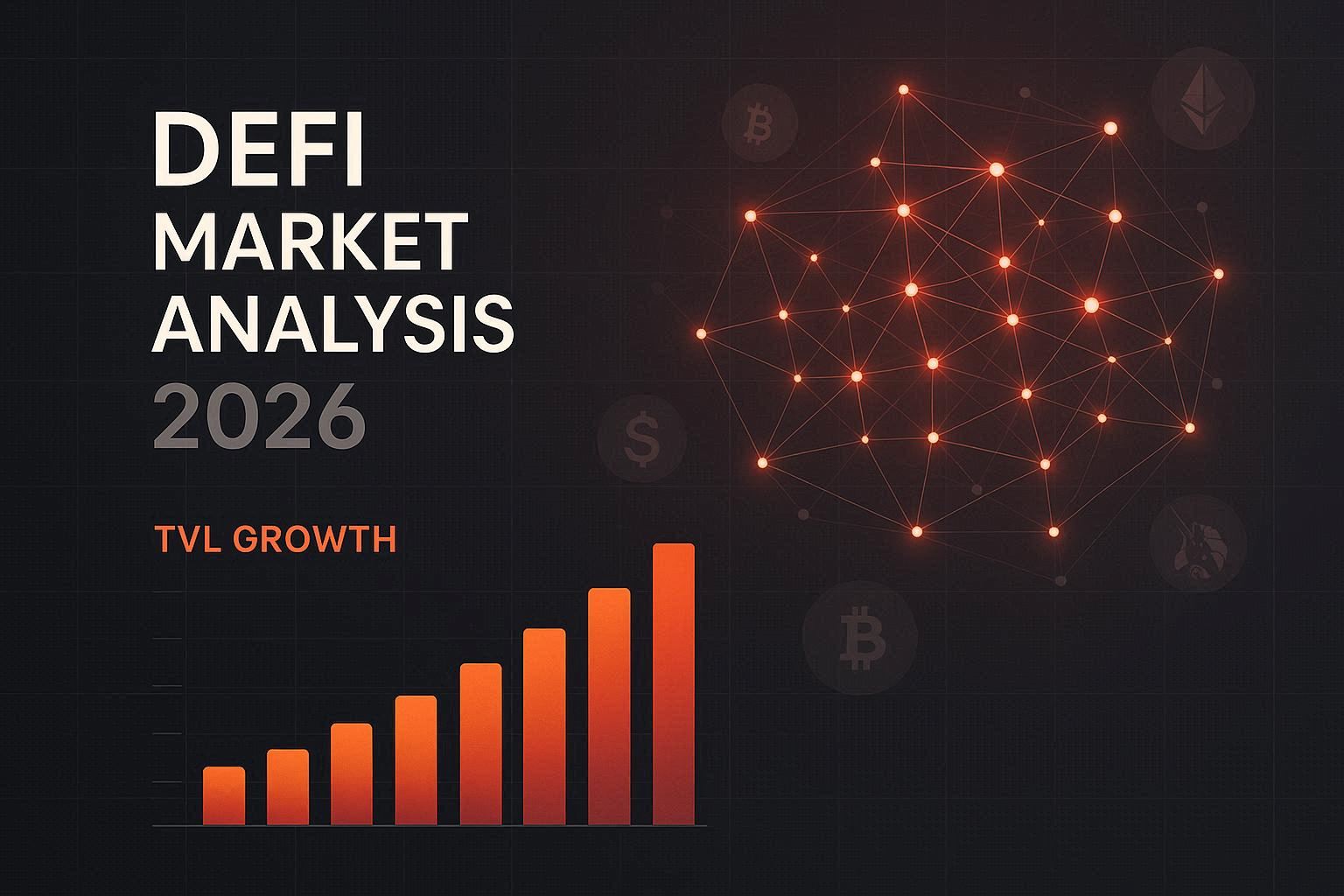
DeFi State of the Market 2026: What You Need to Know
Decentralized finance, or DeFi, has grown up a lot in 2026. After the ups and downs of previous years, DeFi is now stronger than ever with a total of $185 billion locked across all blockchain networks as of March 2026.
In simple terms: DeFi lets people use financial services like lending, borrowing, and trading without banks or middlemen. Think of it as a financial system that runs on code instead of in bank buildings. New to DeFi? Read our complete guide
Quick Numbers for Q1 2026
| Metric | Value | What It Means |
|---|---|---|
| Total Value Locked | $185 billion | +23% from late 2025 - money flowing back into DeFi |
| Active Users | 8.2 million | +45% from last year - more people than ever |
| Institutional Money | 34% of total | Big companies and funds are now using DeFi |
| AI-Integrated Protocols | 127 | Artificial intelligence is being built into DeFi |
Which Blockchains Have the Most Money? (Q1 2026)
When people put their crypto into DeFi, they're spread across many different blockchains. Here's where the money is:
Top 10 Chains by Total Value Locked
| Rank | Blockchain | Total Value | Share of Market | Recent Change |
|---|---|---|---|---|
| 1 | Ethereum | $72.5 billion | 39.2% | +18% |
| 2 | Solana | $28.4 billion | 15.4% | +67% (fastest growing!) |
| 3 | Tron | $18.2 billion | 9.8% | +12% |
| 4 | Binance Smart Chain | $15.8 billion | 8.5% | +8% |
| 5 | Arbitrum | $12.3 billion | 6.6% | +34% |
| 6 | Avalanche | $9.7 billion | 5.2% | +22% |
| 7 | Polygon | $8.1 billion | 4.4% | +15% |
| 8 | Sui | $6.4 billion | 3.5% | +89% (new & growing fast) |
| 9 | Optimism | $5.9 billion | 3.2% | +28% |
| 10 | Base | $5.2 billion | 2.8% | +156% (explosive growth) |
What This Tells Us
-
Ethereum is still king - Nearly 40% of all DeFi money is on Ethereum, mostly from liquid staking and tokenized real-world assets
-
Solana is surging - 67% growth in just one quarter! More people are using Solana for trading and DeFi because it's fast and has low fees
-
Newer chains are gaining ground - Sui and Base are showing massive growth as users look for better user experiences and lower costs
-
Layer 2 solutions are working - Arbitrum and Optimism (which help Ethereum handle more transactions) now hold about 10% of total DeFi value
What is Layer 2? Think of Ethereum as a busy highway. Layer 2s like Arbitrum and Optimism are like express lanes that handle more traffic with lower fees, while still connected to the main Ethereum network.
The Different Types of DeFi Applications
DeFi isn't just one thing - it's a whole ecosystem of different financial tools. Let's break down the biggest categories.
1. Liquid Staking - $58.2 billion total
What it is: Instead of locking up your crypto to earn rewards (which you can't use), liquid staking gives you a token representing your staked crypto that you can still use in other DeFi applications.
Why it's popular: You earn rewards AND keep your money working for you
| Protocol | Total Value | Where It Works |
|---|---|---|
| Lido Finance | $32.1 billion | Multiple blockchains |
| Rocket Pool | $8.4 billion | Ethereum |
| Marinade | $6.2 billion | Solana |
| Coinbase Staked | $4.8 billion | Ethereum |
| Frax Ether | $3.1 billion | Ethereum |
2. Lending & Borrowing - $42.8 billion total
What it is: Just like a bank, you can deposit crypto to earn interest or borrow crypto by putting up collateral. But unlike banks, it's all handled by smart contracts.
Why it's popular: Earn interest on your crypto or get loans without credit checks
| Protocol | Total Value | Specializes In |
|---|---|---|
| Aave V3 | $18.6 billion | General lending on many chains |
| Compound V3 | $12.4 billion | Institutional users |
| JustLend | $5.8 billion | Stablecoin yields on Tron |
| Morpho Blue | $3.2 billion | Permissionless lending |
Growing trend: Real World Assets (RWA) - things like U.S. Treasury bonds and credit - now represent 23% of all lending, up from just 8% in 2025.
3. Decentralized Exchanges (DEXs) - $38.5 billion total
What it is: Trade crypto directly with other people, no centralized exchange needed. You always control your funds.
Why it's popular: No need to trust an exchange with your money, and you can trade thousands of different tokens
New to DEXs? Learn how decentralized exchanges work and why they're different from centralized exchanges.
| Protocol | Total Value | Trading Volume (Q1 2026) | Where It Works |
|---|---|---|---|
| Uniswap V4 | $12.8 billion | $142 billion | Ethereum & L2s |
| Raydium | $8.2 billion | $89 billion | Solana |
| PancakeSwap | $5.4 billion | $52 billion | BNB Chain |
| Curve Finance | $4.8 billion | $38 billion | Multiple chains |
| Orca | $3.1 billion | $41 billion | Solana |
Interesting note: Even though Solana has less total value locked, it handles 35% of all DEX trading volume. This means Solana users trade more frequently and move money faster.
4. Yield Aggregators - $15.2 billion total
What it is: Services that automatically move your money between different DeFi protocols to find the best returns.
Why it's popular: "Set it and forget it" - the strategy keeps changing but you don't have to keep watching
| Protocol | Total Value | Focus |
|---|---|---|
| Yearn Finance | $4.8 billion | Ethereum yields |
| Convex Finance | $3.2 billion | Curve staking rewards |
| Kamino | $2.9 billion | Solana lending |
5. Cross-Chain Bridges - $12.4 billion total
What it is: Ways to move your crypto from one blockchain to another.
Why it's popular: Different blockchains have different applications - bridges let you use your crypto wherever you need it
| Protocol | Total Value | What It Does Best |
|---|---|---|
| Across | $3.8 billion | Intent-based bridging |
| Stargate | $2.9 billion | Stablecoin transfers |
| Wormhole | $2.4 billion | Messaging + bridging |
What is intent-based bridging? Instead of telling the system exactly how to move your crypto, you just say "I want my Solana USDC as Ethereum USDC" and the system figures out the best way to do it.
Who's Using DeFi? (User Growth & Adoption)
Total Active Users: 8.2 million
That's a 45% increase from last year - nearly half again as many people are using DeFi now compared to 2025.
Users by Blockchain
| Blockchain | Active Users | Average Transaction Size | What This Tells Us |
|---|---|---|---|
| Ethereum | 2.1 million | $4,200 | Fewer users, but bigger money |
| Solana | 2.8 million | $380 | More users, smaller amounts |
| BNB Chain | 1.4 million | $280 | Everyday users |
| Polygon | 1.1 million | $180 | Budget-friendly DeFi |
| Arbitrum | 420,000 | $2,100 | Serious DeFi users |
| Base | 380,000 | $220 | Growing mainstream adoption |
Key insight: Solana now has more active users than Ethereum! This is because Solana's low fees (often less than a penny) make it perfect for smaller transactions and everyday trading.
Where Are DeFi Users Located?
Based on where people connect to DeFi websites from:
- Asia Pacific - 38% (led by Vietnam, Philippines, Indonesia)
- North America - 26% (led by USA, Canada)
- Europe - 22% (led by UK, Germany, France)
- Latin America - 9% (led by Brazil, Argentina)
- Middle East & Africa - 5%
User Growth Trends
- New users joining: 67% more than Q1 2025
- Users who stick around (30-day retention): 34% (up from 28% in 2025)
- Users active on multiple blockchains: 2.3 million
- Users coming from mobile wallets first: 58%
What Can You Earn in DeFi Right Now?
Stablecoin Yields (Lower Risk)
Stablecoins are crypto tokens designed to stay worth $1. Here's what you can earn lending them out:
Want to understand stablecoins better? Learn why stablecoins are considered both revolutionary and terrifying
| Platform | What You Lend | Annual Yield | Risk Level |
|---|---|---|---|
| Aave | USDC | 8.2% | Low |
| Compound | USDC | 7.8% | Low |
| JustLend | USDT | 12.4% | Medium (on Tron) |
| Ethena | USDe (synthetic) | 18.6% | Medium (newer) |
| Sui Lending | Various | 15.2% | Medium (new chain) |
What's the catch? Higher yields usually mean higher risk. 18% sounds great, but it might be riskier than 8% from an established protocol.
Crypto Staking Yields
Staking means locking up your crypto to help secure a network and earn rewards:
| Crypto | Protocol | Annual Yield | Type of Reward |
|---|---|---|---|
| ETH (via stETH) | Lido | 3.8% | Staking rewards |
| SOL | Marinade | 7.2% | Staking + MEV |
| ETH | Rocket Pool | 3.5% | Staking rewards |
| RPL | Rocket Pool | 4.1% | Running a node |
What is MEV? It stands for "Maximal Extractable Value" - basically, ways to earn extra rewards by optimizing transaction order.
Points Programs & Airdrop Farming (Higher Risk)
Many newer DeFi protocols reward early users with "points" that might convert to valuable tokens later:
| Protocol | Expected "Points" Yield | Status |
|---|---|---|
| Berachain | 45-65% | Mainnet (retroactive rewards) |
| Monad | 25-40% | Testnet (not live yet) |
| Sonic | 35-50% | Testnet (not live yet) |
| zkLink Nova | 20-30% | Mainnet |
Warning: These yields are speculative. You might get less (or nothing) when the tokens actually launch. Always do your own research.
Big Money Is Coming: Institutional Adoption
One of the biggest changes in 2026 is that big institutions are now using DeFi in a serious way.
Institutional Money in DeFi: $62.9 billion
That's 34% of ALL DeFi value, up from just 22% in 2025.
Who's Putting Money In?
| Type of Institution | Money Added in Q1 2026 | Change from Last Year |
|---|---|---|
| ETF providers | $18.2 billion | +156% (more than doubled!) |
| Corporate treasuries | $12.4 billion | +89% |
| Hedge funds | $8.8 billion | +67% |
| Family offices | $4.2 billion | +45% |
| Venture capital funds | $3.1 billion | +23% |
| Pension funds | $1.8 billion | +312% (massive growth) |
Favorite Protocols for Institutions
- Aave V3 - $12.8 billion from institutions
- Compound - $8.4 billion from institutions
- Lido - $15.6 billion (for ETH staking)
- MakerDAO - $6.2 billion from institutions
- Curve - $4.8 billion from institutions
Real World Assets (RWA) on Blockchain
Real world things like U.S. Treasury bonds, real estate, and corporate credit are being tokenized on blockchains:
- Total: $28.4 billion
- U.S. Treasuries: $12.8 billion (Ondo, Mountain Protocol)
- Credit & loans: $8.2 billion (Centrifuge, MakerDAO)
- Real estate: $3.4 billion (RealT, Tangible)
- Commodities: $2.1 billion (various)
- Corporate bonds: $1.9 billion (various)
Why this matters: Traditional finance (TradFi) and DeFi are merging. Big financial institutions are tokenizing real-world assets and using DeFi protocols to manage them.
AI Meets DeFi: The New Frontier
One of the most exciting developments in 2026 is the integration of artificial intelligence into DeFi. As of March 2026, 127 DeFi protocols are using AI in some way.
What AI is Doing in DeFi
| AI Use Case | Number of Protocols | Money Involved |
|---|---|---|
| Predictive analytics | 34 | $42 billion |
| Automated trading | 28 | $18 billion |
| Risk assessment | 23 | $35 billion |
| Yield optimization | 21 | $15 billion |
| Fraud detection | 15 | $8 billion |
| Smart contract security | 6 | N/A |
Notable AI + DeFi Projects
- Giza Network - AI that optimizes yield farming strategies ($2.8 billion managed)
- Napier AI - Predicts liquidity needs before they happen ($1.4 billion managed)
- Alluvium - AI-powered market making on DEXs
- Ritual - AI agents that automate DeFi operations
Prediction: By end of 2026, we expect 40% of DeFi protocols to have AI built into their core functionality.
What's Coming in Q2 2026?
Based on what we're seeing in Q1, here are our predictions for the next quarter:
1. Solana Will Keep Growing
Solana's total value locked could reach $45-50 billion by end of Q2, driven by:
- Continued memecoin and trading activity
- New DeFi protocols launching on Solana
- Better bridges to move money between Solana and Ethereum
2. Points Programs Will Start Paying Out
Many points programs will start distributing tokens in Q2-Q3 2026, which could cause:
- $8-12 billion to move around as users chase new opportunities
- Some disappointment if token distributions are lower than expected
- More caution from users after several underwhelming airdrops
3. Real World Assets Will Accelerate
RWA tokenization could grow to $40+ billion by end of Q2, thanks to:
- More traditional finance companies launching tokenized products
- BlackRock's BUIDL fund expanding to more blockchains
- New regulations making it clearer how tokenized assets work
4. AI + DeFi Will Explode
We expect 50+ new AI-integrated DeFi protocols to launch in Q2 2026, with combined total value reaching $5 billion by end of quarter.
5. Ethereum Layer 2s Will Gain More Ground
Arbitrum and Optimism could together hold 15%+ of all DeFi value as users move from expensive Ethereum transactions to cheaper Layer 2 alternatives.
6. New Stablecoin Models
Synthetic dollar protocols (like Ethena) could grow to $10+ billion, challenging traditional stablecoins with higher yields.
7. Cross-Chain Movement Will Get Smoother
Intent-based bridging (like Across) could handle 40% of cross-chain transfers, making it much easier to move money between blockchains.
Risks to Watch Out For
While things look good for DeFi in 2026, there are still real risks:
Smart Contract Risks
- Average hack size in Q1 2026: $8.4 million per incident
- Total lost to hacks: $142 million
- Main risk types: Oracle manipulation (34%), bridge exploits (28%), code bugs (22%)
What is oracle manipulation? DeFi protocols rely on price feeds called "oracles." Attackers can manipulate these prices to steal funds. It's like tricking a price scanner at a store.
Regulatory Risks
- MiCA (EU regulations): Full implementation expected Q2 2026
- US Stablecoin Act: Pending legislation that could affect major stablecoin issuers
- DeFi KYC requirements: Growing pressure in many countries to add identity verification
Market Risks
- DeFi now moves 72% in sync with traditional markets (used to be more independent)
- Smaller protocols can still have liquidity problems
- Top 10 protocols control 68% of all DeFi value (concentration risk)
How We Got This Data
This report combines data from:
- DefiLlama - Total value locked and protocol rankings
- Dune Analytics - User behavior and on-chain data
- CoinMarketCap - Price information
- Glassnode - On-chain metrics
- Messari - Institutional adoption data
- Chainalysis - Geographic user distribution
- Individual protocol dashboards and APIs
Data collected: January 1 - March 26, 2026 Last updated: March 26, 2026
What This All Means
DeFi in 2026 has matured into a real, significant part of the financial system. The key takeaways:
-
Institutional adoption is real - 34% of DeFi value comes from big institutions, not just individual users
-
Multi-chain is the new normal - No single blockchain dominates. Money and users are spread across many networks
-
AI is transforming DeFi - Machine learning is being built into everything from trading to security
-
Real-world assets are here - Traditional assets like Treasury bonds are being tokenized and used in DeFi
-
User experience is getting better - Mobile-first design is making DeFi accessible to everyone, not just tech enthusiasts
For Q2 2026, we expect continued growth driven by:
- Solana's expanding ecosystem
- More real-world assets coming on-chain
- AI-powered DeFi protocols
- Better cross-chain experiences
Total DeFi value could reach $220-240 billion by end of Q2 2026.
Related Reading
Want to dive deeper into DeFi? Here are some essential guides:
-
DeFi Explained: A Free Financial Market That Doesn't Sleep - Our complete beginner's guide to understanding DeFi
-
What is a DEX? Your Ultimate Guide to Decentralized Exchanges - Learn how DEXs work and why they're different from centralized exchanges
-
Understanding Liquidity Pools - How liquidity pools enable DeFi trading
-
Top 3 DeFi Analytics Platforms - Tools to track and analyze DeFi protocols
-
Is DeFi Legal? Understanding the Regulations - What you need to know about DeFi regulations
-
Stablecoins: The Terrifying Technology - Understanding stablecoins and their risks
-
Explore More DeFi Content - Visit our DeFi hub for all DeFi-related articles
Want more? This report will be updated quarterly. Follow Resh Community for the Q2 2026 report coming in June.
📥 Download the Data
Get the full dataset as a CSV file for your own analysis:
Download DeFi Q1 2026 Dataset (CSV)
File includes: TVL by chain, protocol rankings, user metrics, yields, institutional data, and more.
Share this article: Help others understand DeFi in 2026 by sharing on Twitter or LinkedIn.
Comments